
- Quick Answer (TL;DR)
To increase dumpster turns without purchasing more containers, focus on shortening the non-revenue time between rentals. Know where every dumpster is, identify containers sitting too long at jobsites or in the yard, schedule pickups promptly, coordinate swaps efficiently, track demand by dumpster size, and use reporting to find underused inventory. Better fleet visibility can reveal capacity that already exists inside your operation. See how Bin Boss can help you get more from the dumpsters you already own.
Are You Really Short on Dumpsters—or Are They Just Turning Too Slowly?
A busy schedule can make it feel like the obvious next move is buying more dumpsters.
A customer asks for a 20-yard container and none are available. Another job needs a swap. Two boxes are still sitting at completed projects. Suddenly, adding five or ten more containers sounds like the fastest way to create capacity.
Sometimes expansion is justified.
But before spending more capital, ask a different question: How efficiently are the dumpsters you already own moving through the rental cycle?
For this article, think of a “turn” as one completed rental cycle—from a dumpster being available, to going out on a rental, to being picked up and made ready for the next customer. The more unnecessary downtime inside that cycle, the fewer revenue-producing rentals each container can complete.
That is where a fleet can appear smaller than it really is.
The Hidden Capacity Problem Inside a Dumpster Fleet
Many dumpster rental operators assume growth requires more equipment when the real issue is utilization.
A container can be unavailable without actually being productive. It may be sitting at a finished job waiting for pickup. It may have returned to the yard but still be marked incorrectly. A driver may not know it is ready. Dispatch may schedule around incomplete information.
Multiply those small delays across dozens of containers, and real capacity disappears.
Missed pickups, slow swaps, unclear dumpster availability, inefficient roll-off scheduling, and poor visibility into container locations can quietly reduce dumpster turnover. The company may then buy additional boxes without correcting the bottlenecks slowing the original fleet.
“Before buying another dumpster, make sure the ones you already own are turning as often as they should. Better visibility and faster rotation can create more rental capacity without adding another container to the yard.”
- — Todd Atkinson
How to Get More Turns From the Fleet You Already Own
Know the Status of Every Dumpster
You cannot improve dumpster fleet utilization if nobody is completely sure where the inventory is.
Every container should have a clear status. Is it available? Out on a job? Pending pickup? On a truck? Waiting for cleaning? Damaged? Ready at the yard?
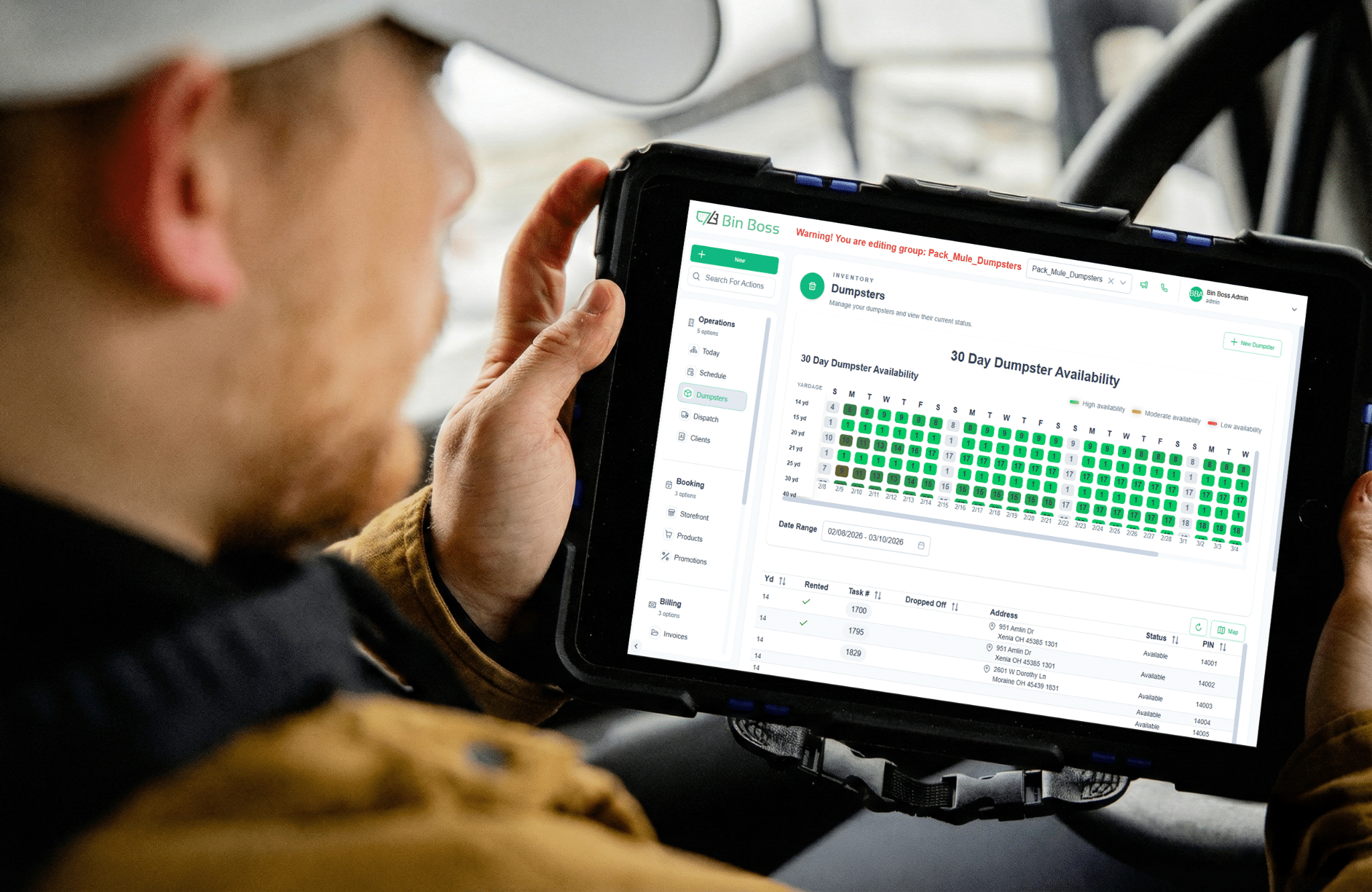
Bin Boss’s dumpster tracking software allows operators to assign individual box numbers, track locations, use custom statuses, and see which dumpsters are available for upcoming jobs. Drivers can also update statuses from the field.
That creates a more reliable answer to a critical question: What can we rent next?
Find Containers That Have Been Sitting Too Long
Container aging deserves regular attention.
A long rental is not automatically a problem if the customer is paying appropriately and the rental is operating as intended. The problem is a container sitting longer than necessary because nobody recognized that it could be picked up, swapped, cleaned, or reassigned.
Review dumpsters by how long they have been at their current status or location.
Look for containers that are:
- Pending pickup longer than expected
- Sitting idle at the yard
- Waiting unnecessarily for cleaning or repair
- Assigned to completed jobs
- Consistently underused compared with other sizes
The objective is not to rush paying customers. It is to remove avoidable downtime.
Tighten Pickup and Swap Coordination
The hours and days between “customer is done” and “container is ready again” matter.
Build a clear process for pickup requests. Make sure dispatch sees them quickly. If a contractor needs a swap, the outgoing and incoming movements should be coordinated so both the customer and fleet stay productive.
Bin Boss’s dispatch system supports scheduling deliveries, pickups, swaps, and driver assignments from one dispatch view, with changes pushed to drivers as schedules change.
Faster does not mean reckless. Routes, disposal runs, driver availability, service promises, and operating costs still matter. The goal is to remove preventable delays.
Match Inventory to Actual Demand
Not every dumpster size turns at the same rate.
You may have plenty of total containers but still experience constant shortages in one size while another sits unused.
Track job volume and revenue by size. Compare demand over meaningful periods rather than relying on memory.
Bin Boss’s dumpster rental reporting includes fleet-utilization visibility, job data, time-frame filtering, and revenue breakdowns by dumpster size. Those reports can help operators identify where equipment is being used heavily and where inventory may be underperforming.
That information is especially valuable before purchasing additional containers. If one size is consistently constrained while another has significant idle time, the purchasing decision becomes much clearer.
Reduce Yard Time Between Rentals
A dumpster that comes back to the yard is not necessarily ready for another customer.
It may need inspection, cleaning, maintenance, or repair. Those steps are necessary—but an undefined process can turn several hours into several days.
Create a simple turnaround workflow:
Pickup → dump → inspect → clean or repair → update status → ready for delivery.
When everybody knows where a container is in that process, the next rental can be scheduled with more confidence.
6 Steps to Increase Dumpster Turns Today
#1 Audit every container.
Identify its current location, status, and how long it has been there.
#2 Review pending pickups.
Find completed rentals that can be brought back into rotation sooner.
#3 Measure utilization by dumpster size.
Determine which sizes are constantly moving and which spend more time idle.
#4 Standardize your turnaround process.
Make cleaning, inspection, repair, and “ready” status updates part of a defined workflow.
#5 Improve pickup and swap scheduling.
Coordinate drivers, disposal runs, and upcoming orders so containers spend less time waiting between jobs.
#6 Review the data before buying equipment.
Confirm that demand truly exceeds efficient fleet capacity before investing in additional containers.
When Slow Turns Start Creating Expensive Problems
One dumpster sitting an extra day may not seem important.
Across an entire fleet, it can become a pattern.
As more containers sit at completed jobs, remain pending pickup, or wait unnecessarily in the yard, available inventory shrinks. Customers begin hearing that the size they want is unavailable. Dispatch works around artificial shortages. Drivers may make extra trips. Meanwhile, containers that could be earning revenue remain idle.
Then comes the expensive conclusion: “We need more dumpsters.”
Containers start sitting too long
Completed jobs, delayed pickups, and idle yard inventory keep dumpsters out of circulation longer than necessary.
Available inventory starts shrinking
Customers hear that sizes are unavailable while dispatch works around shortages created by slow container rotation.
The business thinks it needs more dumpsters
New container purchases may add capacity without fixing the scheduling, tracking, and turnaround problems causing the shortage.
Better utilization reveals the real need
Track aging, pickups, swaps, statuses, and demand by size to see whether the fleet needs to grow or simply turn faster.
Buying additional containers may increase capacity, but it does not solve a broken rotation process. If the same scheduling, tracking, and turnaround problems continue, the expanded fleet can eventually develop the same inefficiencies.
The stronger approach is to treat every dumpster as a revenue-producing asset whose movement should be visible from rental to rental.
Track container aging. Keep statuses current. Schedule pickups promptly. Coordinate swaps. Monitor dumpster fleet utilization. Compare demand by size.
Only then can you tell whether the business genuinely needs more inventory—or simply needs to get more from what it already owns.
- Key Takeaway
- More dumpsters do not automatically mean better utilization.
- Before expanding the fleet, identify containers sitting too long, tighten pickups and swaps, improve status visibility, and measure which dumpster sizes are actually in demand.
- Better scheduling and reporting can reveal unused capacity inside the fleet you already own
- Increase dumpster turns first, then make equipment purchases based on real operational data.
Get More Revenue From the Fleet Before Expanding It
There is nothing wrong with buying more containers when customer demand supports the investment.
But fleet expansion should be a decision backed by operational data, not a reaction to poor visibility.
Bin Boss is dumpster management software built by haulers for dumpster rental companies across the United States. The platform brings dumpster tracking, dispatch, driver tools, inventory management, reporting, invoicing, CRM, and other operating functions into one system. Its reporting dashboard includes fleet-utilization and job data, while its inventory tools help operators see container locations and statuses.
Before adding more steel to the yard, find out whether better container rotation can unlock more capacity first.
Ready to see how your operation could run with clearer inventory and fleet visibility? request a Bin Boss demo and explore the platform.
Ready to Turn Your Website Into a 24/7 Revenue Machine?
Request a demo today and see how BinBoss can transform your business.
Frequently Asked Questions
How do you increase dumpster turns?
Reduce unnecessary downtime between rentals by tracking container locations and statuses, scheduling pickups promptly, coordinating swaps, and getting returned dumpsters ready for the next delivery quickly. Measuring utilization by dumpster size can also reveal where capacity is being lost.
What is dumpster fleet utilization?
Dumpster fleet utilization describes how effectively a company’s available containers are being used. Operators can monitor how many containers are actively rented versus sitting idle, pending pickup, awaiting service, or available at the yard.
How do I know if I need to buy more dumpsters?
First determine whether customer demand consistently exceeds the capacity of an efficiently managed fleet. If containers are already turning quickly and high-demand sizes remain unavailable despite good scheduling and minimal idle time, additional inventory may be justified.
Why are my dumpsters sitting idle?
Common causes can include uneven demand by size, delayed pickups, seasonal changes, weak scheduling, containers awaiting cleaning or repairs, and poor visibility into available inventory. Reviewing container status and utilization data can help determine which issue is affecting the fleet.
Can dumpster management software improve fleet utilization?
It can provide the visibility needed to manage utilization more deliberately. Tracking container locations and statuses, coordinating dispatch, and reviewing fleet and job data can help operators identify idle inventory and make better scheduling and purchasing decisions.